Circuits.
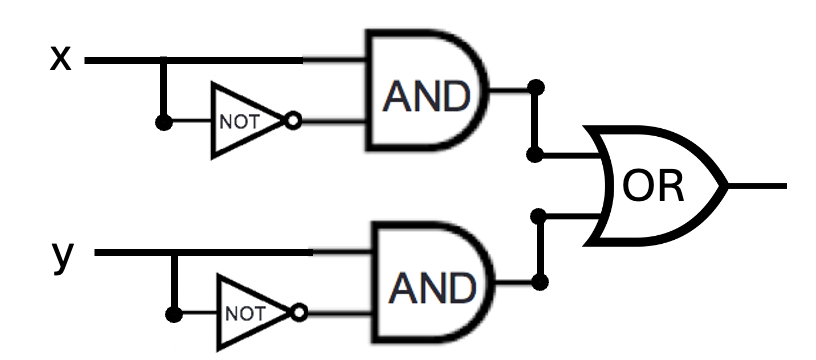
Consider the circuit below with inputs \(x\) and \(y\). Can one of the AND gates be exchanged with the OR gate without changing the input-output table of the circuit? If so, write out the input-output table that results, and briefly explain why this exchange works. If not, explain why not with reference to the definitions of the logic gates.
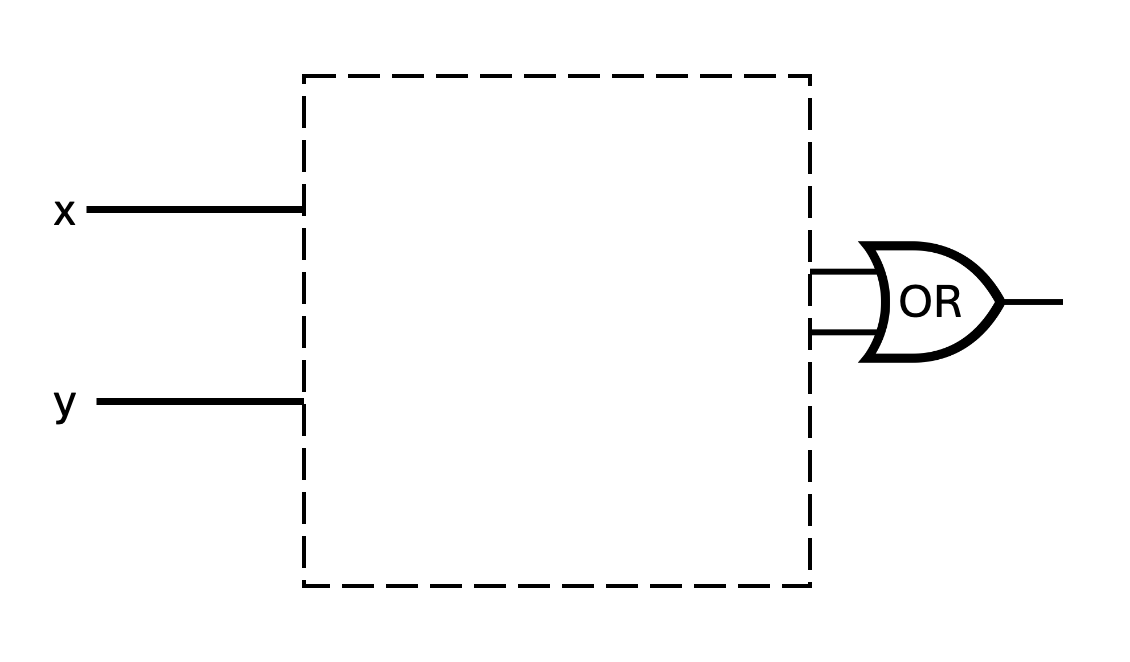
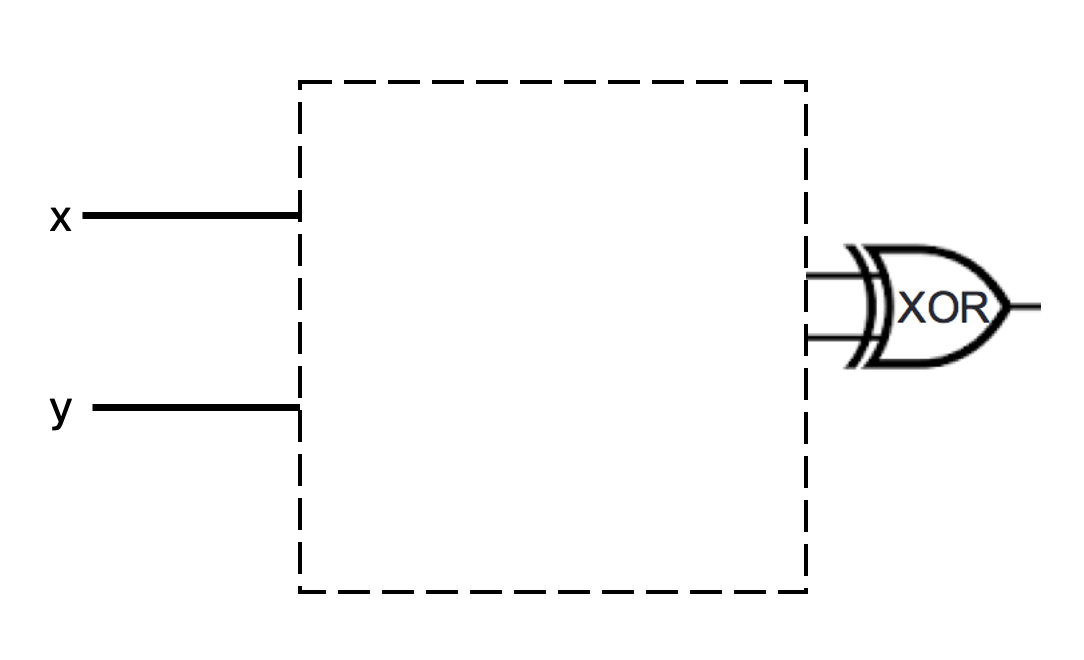
Is there a way to fill in the blank portion of the two logic circuits below *with the same gates connected in the same way* so that the resulting circuits have the same input-output value *even though* one uses an OR gate at the end and the other uses an XOR gate? If so, design the circuit that would be used, write out the input-output table that results, and briefly explain why your design works. If not, explain why not with reference to the definitions of the logic gates.
2
Compound propositions. The set of strings of length \(4\) whose characters are \(0\)s or \(1\)s is the result of four successive set-wise concatenations: \(\{0,1\} \circ \{0,1\} \circ \{0,1\}\circ \{0,1\}\). Let’s call this set \(X_4\). Consider the function \(f: X_4 \to X_4\) defined by \[f(x) = \begin{cases} y &\text{when $(x)_{2,4} < 15$ and $(y)_{2,4} = (x)_{2,4} + 1$}\\ 1111 &\text{when $x = 1111$} \end{cases}\] for each \(x \in X_4\). In other words, we can describe the function as: \(f\) takes a string, interprets it as the binary fixed-width \(4\) expansion of an integer, and then adds \(1\) to that integer (unless \(x\) is already representing the greatest integer that can be represented in binary fixed-width \(4\)) and outputs the binary fixed-width \(4\) expansion of the result.
Fill in the blanks in the following input-output definition table with four inputs \(x_3\), \(x_2\), \(x_1\), \(x_0\) and four outputs \(y_3\), \(y_2\), \(y_1\), \(y_0\) so that \(f(x_3x_2x_1x_0) = y_3y_2y_1y_0\). Remember to explain all your answers.
\(x_3\) \(x_2\) \(x_1\) \(x_0\) \(y_3\) \(y_2\) \(y_1\) \(y_0\) \(1\) \(1\) \(1\) \(1\) \(1\) \(1\) BLANK1 \(1\) \(1\) \(1\) \(1\) \(0\) \(1\) \(1\) \(1\) \(1\) \(1\) \(1\) \(0\) \(1\) \(1\) BLANK2 \(1\) \(0\) \(1\) \(1\) \(0\) \(0\) \(1\) \(1\) \(0\) \(1\) \(1\) \(0\) \(1\) \(1\) \(1\) \(1\) \(0\) \(0\) \(1\) \(0\) \(1\) \(0\) \(1\) \(0\) \(1\) \(1\) \(1\) \(0\) \(0\) \(1\) \(1\) \(0\) \(1\) \(0\) \(1\) \(0\) \(0\) \(0\) BLANK3 \(0\) \(0\) \(1\) \(0\) \(1\) \(1\) \(1\) \(1\) \(0\) \(0\) \(0\) \(0\) \(1\) \(1\) \(0\) \(0\) \(1\) \(1\) BLANK4 \(0\) \(1\) \(0\) \(1\) \(0\) \(1\) \(1\) BLANK5 \(0\) \(1\) \(0\) \(0\) \(0\) \(1\) \(0\) \(1\) \(0\) \(0\) \(1\) \(1\) \(0\) \(1\) \(0\) \(0\) \(0\) \(0\) \(1\) \(0\) \(0\) \(0\) \(1\) \(1\) \(0\) \(0\) \(0\) \(1\) \(0\) \(0\) \(1\) \(0\) \(0\) \(0\) \(0\) \(0\) BLANK6 \(0\) \(0\) \(1\) Construct an expression (as a compound proposition) for each of \(y_0\), \(y_1\), \(y_2\), and \(y_3\) in terms of the inputs \(x_3, x_2, x_1, x_0\). Justify your expression by referring to the definition of the logic gates XOR, AND, OR, NOT and the definition of the function \(f\). Hint: our work on the half-adder might be helpful.
Draw a combinatorial circuit corresponding to two (or more) of these (output) compound propositions. Remember that the symbols for the inputs will be on the left-hand-side and the symbol for the outputs \(y_0\) and/or \(y_1\) and/or \(y_2\) and/or \(y_3\) will be on the right-hand side. Use gates (draw the appropriate shapes and add labels for clarity) and wires to connect the inputs appropriately to give the output.
Logical Equivalence. Imagine a friend suggests the following argument to you: “The compound proposition \[(x \lor y) \land z\] is logically equivalent to \[x \lor (y \land z)\] because I can transform one to the other using the following sequence of logical equivalences: \[(x \lor y) \land z \equiv (x \lor (y \land y)) \land z \equiv x \lor ( (y \lor y) \land z) \equiv x \lor (y \land z)\] because \(y\) is logically equivalent to both \(y \land y\) and to \(y \lor y\)".
Prove to your friend that they made a mistake by giving a truth assignment to the propositional variables \(x,y,z\) so that the two compound propositions \((x \lor y) \land z\) and \(x \lor (y \land z)\) have different truth values. Justify your choice by evaluating these compound propositions using the definitions of the logical connectives and include enough intermediate steps so that a student in CSE 20 who may be struggling with the material can still follow along with your reasoning.
Help your friend find the problem in their argument by pointing out which step(s) were incorrect and why.
Give three different compound propositions that are actually logically equivalent to (and not the same as) \[(x \lor y) \land z\] Justify each one of these logical equivalences either by applying a sequence of logical equivalences or using a truth table. Notice that you can use other logical operators (e.g. \(\lnot, \lor, \land, \oplus, \to, \leftrightarrow\)) when constructing your compound propositions.
Bonus; not for credit (do not hand in): How would you translate each of the equivalent compound propositions in English? Does doing so help illustrate why they are equivalent?
Evaluating predicates. Consider the following predicates, each of which has as its domain the set of all bitstrings whose leftmost bit is \(1\)
\(E(x)\) is \(T\) exactly when \((x)_{2}\) is even, and is \(F\) otherwise
\(L(x)\) is \(T\) exactly when \((x)_2 < 15\), and is \(F\) otherwise
\(M(x)\) is \(T\) exactly when \((x)_2 > 2\) and is \(F\) otherwise.
Sample response that can be used as reference for the detail expected in your answer: To prove that the statement \[\forall x ~L(x)\] is false, we can use the counterexample \(x = 1111\), which is a bitstring whose leftmost bit is \(1\) (so is in the domain). Applying the definition of \(L(x)\), since \((1111)_2 = 1 \cdot 2^3 + 1\cdot 2^2 + 1 \cdot 2^1 + 1 \cdot 2^0 = 8 + 4+2+1 = 15\) which is not (strictly) less than \(15\), we have that \(L(1111) = F\) and so the universal statement is false.
Use a counterexample to prove that the statement \[\forall x ( ~L(x) \to E(x)~)\] is false. Your proof needs to include references to the relevant definitions.
Use a witness to prove that the statement \[\exists x (~L(x) \land M(x) ~)\] is true. Your proof needs to include references to the relevant definitions.
Translate each of the statements in the previous two parts to English.
Set properties. Let \(W = \mathcal{P}(\{1,2,3,4,5\})\).
Sample response that can be used as reference for the detail expected in your answer for parts (a) and (b) below:
To give an example element in the set \(\{ X \in W ~|~ 1 \in X \} \cap \{ X \in W ~|~ 2 \in X \}\), consider \(\{ 1,2\}\). To prove that this is in the set, by definition of intersection, we need to show that \(\{1,2\} \in \{ X \in W ~|~ 1 \in X \}\) and that \(\{1,2\} \in \{ X \in W ~|~ 2 \in X \}\).
By set builder notation, elements in \(\{ X \in W ~|~ 1 \in X \}\) have to be elements of \(W\) which have \(1\) as an element. By definition of power set, elements of \(W\) are subsets of \(\{1,2,3,4,5\}\). Since each element in \(\{1,2\}\) is an element of \(\{1,2,3,4,5\}\), \(\{1,2\}\) is a subset of \(\{1,2,3,4,5\}\) and hence is an element of \(W\). Also, by roster method, \(1 \in \{1,2\}\). Thus, \(\{1,2\}\) satisfies the conditions for membership in \(\{ X \in W ~|~ 1 \in X \}\).
Similarly, by set builder notation, elements in \(\{ X \in W ~|~ 2 \in X \}\) have to be elements of \(W\) which have \(2\) as an element. By definition of power set, elements of \(W\) are subsets of \(\{1,2,3,4,5\}\). Since each element in \(\{1,2\}\) is an element of \(\{1,2,3,4,5\}\), \(\{1,2\}\) is a subset of \(\{1,2,3,4,5\}\) and hence is an element of \(W\). Also, by roster method, \(2 \in \{1,2\}\). Thus, \(\{1,2\}\) satisfies the conditions for membership in \(\{ X \in W ~|~ 2 \in X \}\).
Give two (different) example elements in \[W \times \mathcal{P}(W)\] Justify your examples by explanations that include references to the relevant definitions.
Give one example element in \[\{ X \in W \mid (1 \in X) \land (X \cap \{3,4\} = \emptyset) \}\] Justify your example by explanations that include references to the relevant definitions.
Consider the following statement and attempted proof:
\[\forall A \in W \, \forall B \in W ~\left(~((A \cap B) \subseteq A) \to (A \subseteq B)~\right)\]
(1) Towards a universal generalization argument, choose arbitrary \(A \in W, B \in W\) .
(2) We need to show \(((A \cap B) \subseteq A) \to (A \subseteq B)\).
(3) Towards a proof of the conditional by the contrapositive, assume \(A \subseteq B\), and we need to show that \((A \cap B) \subseteq A\).
(4) By definition of subset inclusion, this means we need to show \(\forall x ~( x \in A \cap B \to x \in A ~)\).
(5) Towards a universal generalization, choose arbitrary \(x\); we need to show that
\(x \in A \cap B \to x \in A\).(6) Towards a direct proof, assume \(x \in A \cap B\), and we need to show \(x \in A\).
(7) By definition of set intersection and set builder notation, we have that \(x \in A \land x \in B\).
(8) By the definition of conjunction, \(x \in A\), which is what we needed to show. QED
Demonstrate that this attempted proof is invalid by providing and justifying a counterexample (disproving the statement). Then, explain why this attempted proof is invalid by identifying in which step a definition or proof strategy is used incorrectly, and describing how the definition or proof strategy was misused.